𝐓𝐡𝐞 𝐕𝐚𝐧𝐢𝐬𝐡𝐢𝐧𝐠 𝐖𝐚𝐭𝐞𝐫 𝐓𝐨𝐰𝐞𝐫𝐬: 𝐇𝐨𝐰 𝐌𝐞𝐥𝐭𝐢𝐧𝐠 𝐆𝐥𝐚𝐜𝐢𝐞𝐫𝐬 𝐓𝐡𝐫𝐞𝐚𝐭𝐞𝐧 𝐖𝐚𝐭𝐞𝐫 𝐒𝐞𝐜𝐮𝐫𝐢𝐭𝐲

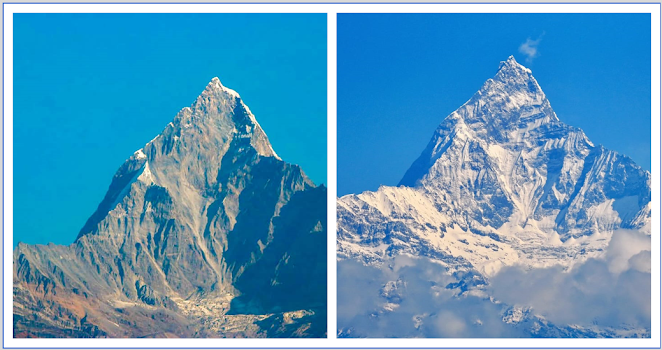
I captured this photograph just after the heavy rainfall last week. The sky had cleared, and the Himalayan mountains were glowing in the golden light. It was a beautiful sight. But looking at those mountains also made me think about how vulnerable they have become and how much is at stake for millions of people who depend on them.
We talk about development, economic growth, and prosperity. We talk about building wealth and improving people's lives. But somewhere along the way, we seem to have forgotten that development cannot be sustainable if it comes at the cost of our planet, our natural resources, and the lives and livelihoods of others.
Every year, thousands of conferences, workshops, policy dialogues, and international gatherings take place around the world. Climate change, rising temperatures, melting glaciers, water insecurity, and environmental degradation are discussed repeatedly. We hear commitments, recommendations, and ambitious promises, particularly at the Conference of the Parties (COP).
But I often wonder: how much of this discussion actually translates into action?
Those who speak most about climate change, environmental protection, and the principle of doing no harm are not always the ones practicing what they preach. We hear about the impacts of greenhouse gas emissions, unsustainable economic activities, and the need for a green transition. Yet, the countries and industries that have contributed most to the climate crisis have not taken responsibility at the scale required.
I have attended, participated in, and listened to some of the discussions. I have heard experts share their knowledge, seen impressive presentations, and listened to powerful speeches. Much of what they say is important and necessary. But there is a growing frustration when the words and actions do not match.
Sometimes, I cannot help asking whether climate change has become a political agenda for politicians, a research opportunity for academics, a professional field for experts, and a project opportunity for the development sector. These roles are important, of course. But if all the discussions continue without meaningful action, what difference are we really making?
The people living in the mountains do not have the luxury of treating climate change as a discussion for tomorrow. They are already living with its consequences today. For them, uncertainty is not a future scenario. It is part of everyday life. They do not know what tomorrow will bring, whether their water sources will remain, whether their crops will survive, or whether their homes and livelihoods will be safe.
Coming back to the photograph, there is another detail that caught my attention. Alongside the mountains, I deliberately captured the water tank standing in our neighborhood. It is part of our local drinking water system, supplied by the Godawari River, which originates near the Godawari forest below the surrounding hills, close to Kathmandu.
As someone working in the development sector, this immediately connected two things in my mind: the mountains in the distance and the water we depend on in our everyday lives.
Our mountains are not simply beautiful landscapes. They are our natural water towers and lifelines. The rivers, streams, springs, and water sources that sustain mountain communities and people living downstream depend heavily on the health of these mountain ecosystems. Glaciers, snow cover, forests, and natural water systems are all connected.
But what happens when these lifelines begin to disappear?
What happens when glaciers shrink, springs dry up, rivers become unpredictable, and water sources can no longer sustain the communities that depend on them?
For many mountain communities, this is not an abstract environmental concern. It is a question of survival. People may have to walk farther for drinking water, find alternative sources, change their livelihoods, or even leave their ancestral homes. And the consequences do not stop in the mountains. Millions of people living downstream also depend on these same rivers and water systems.
We often discuss the economic implications of climate change, including hydropower, agriculture, infrastructure, and national development. These are certainly important. But before discussing economic losses, we must recognize something more fundamental: water is essential for life. For a family with no reliable source of drinking water, the loss of a spring or river is not just an environmental problem. It is a threat to their survival.
That is why protecting our mountains and water sources must be a priority, not just another topic on the agenda of international conferences. I am not against conferences, policy discussions, research, or international commitments. We need all of them. But they must lead to action. We cannot continue making commitments while allowing the same destructive practices to continue.
My message is simple: whatever you talk about, start acting on it. Start with yourself, your family, and your community. Make changes today, not tomorrow. If we are genuinely concerned about climate change, we must demonstrate that concern through our decisions, investments, policies, and everyday actions.

Providing relief and emergency support to affected communities is essential. I deeply respect those who stand with people during difficult times. But we must also ask ourselves why the same communities continue to suffer, year after year. Why are we not doing enough to reduce their risks before disasters happen?
Our responsibility should not begin only after people have lost their homes, livelihoods, water sources, and, sometimes, their loved ones. We must work with communities, strengthen local systems, protect natural resources, and invest in measures that prevent or reduce future losses.
Otherwise, we risk creating a cycle in which people suffer, organizations respond, reports are published, projects close, and the same problems return. Let us not wait until our natural water towers disappear to realize their importance. Let us not wait until communities are forced to migrate before recognizing their vulnerability.
Our mountains are our lifelines. Protecting them is not a choice for the future; it is a responsibility we must act on today.
Thank you for taking the time to read this. These are the thoughts that were running through my mind while capturing these photographs.


Comments
Post a Comment